


Is my website part of what AI models will learn from?
Possibly, but a small business website is unlikely to change what an AI model knows.
AI models are trained on very large collections of text taken from the web. A simple business website is a tiny part of that collection. Unless many other sites write about you, a model may know nothing about your business, or only a little, and sometimes get it wrong.
Models are trained before they are released, so they learn from pages gathered months or years earlier. What you publish today will not change a model that already exists. Future models will learn in the same way, so the same limits apply.
So, trying to get into the training data of an AI is not where a small business should spend its energy. You can’t control it, and you can’t measure it.

How do AI tools find a small business today?
Mostly by looking things up at the moment someone asks.
Many assistants search the web, read a few pages, and then write an answer. This is where your website matters. If a page clearly says what you do, where you work, and who you help, an assistant can use it. If the page is vague, or its text is only inside images or pop-ups, it has nothing to use.
This also means you can act on it. A page you fix today can be found tomorrow.

What should my website say so AI can understand my business?
Say the basics in plain text, near the top of each page.
Write what you are, what you offer, where you are, and who you serve. For example: “We are a family dental clinic in Leeds. We treat adults and children, and we are open Monday to Saturday.” A sentence like that is easy for a person to read and easy for a machine to quote.
Then keep these habits:
Use one name for your business, everywhere. “Dr. Lee’s Family Dental” and “Lee Dental Clinic” may look like two businesses to a machine.
Use the words your customers use. If people say “wedding photographer,” don’t write only “visual storyteller.”
Answer real questions. How much does it cost? Do you deliver to my area? How long does it take? A short page with honest answers is often what an assistant quotes.
Put facts in text, not only in images or PDFs. Machines read text much more reliably than a photo of a price list.
Keep it current. Old prices and wrong opening hours hurt you with people and with machines.

How do I make my website a reliable source about my business?
Think of your website as the place where the facts are right, and everything else points to it.
For that to work, three things must be true. The facts are complete: name, services, location, contact details, prices or price ranges. The facts are consistent: your site, your Google Business Profile, and your social accounts all say the same thing. And the facts are up to date, with one person responsible for checking them.
Technical basics matter too. Your site should be indexed by Google and Bing, which means your pages can appear in their search results. You can test this using our guide, How to Check Where Your Website Appears on Google.
• Your site should also load quickly, because many visitors will see it on a phone, and it should not stop search engines from reading it.
• Your pages should keep the same addresses over time, so links to them don’t break.
A simple test: write down ten facts a stranger would need about your business. For each one, check three things.
• Is it on your site in plain text?
• Does it match everywhere else?
• Is it current? Fix any “no” first.
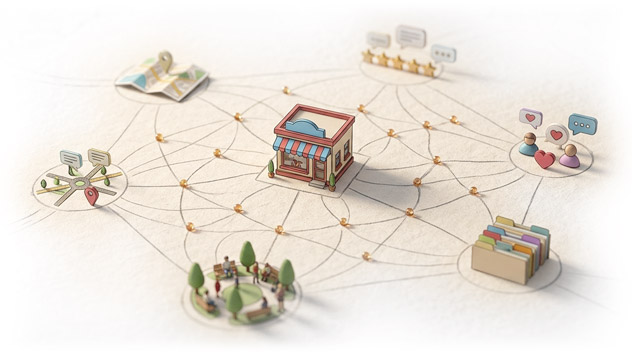
Besides my website, how can my business be visible to AI?
Your website is necessary, but other places count too. For a small business they often count as much.
Business profiles.
Google Business Profile, Apple Business Connect, and Bing Places feed many assistants and map tools. Complete them fully.
Reviews.
Detailed reviews on Google, Trustpilot, or Tripadvisor are read by search tools. Replying to them helps too.
Directories.
Use the ones relevant to your trade and/or city, with the same name, address, and phone number as on your site.
Mentions on other sites.
A local newspaper, a partner’s website, a blog post, or a “best of” list. Independent mentions are the nearest thing to proof that you exist.
Communities.
Forums and discussion sites are often searched. Take part honestly. Self-promotion usually backfires.
Video and social profiles.
Clear titles and descriptions help, because the text around them is read too.
For more on helping people find you, see Help People Find Your Business and What Your Website Does That Social Media Can’t.

Can anyone guarantee that AI will mention my business?
No. Be careful with anyone who says they can.
AI Assistants differ, they change often, and their makers don’t publish exactly how they choose sources.
What you can do is make your business easy to find, easy to understand, and consistent across places. That also helps your human visitors, which is the better reason to do it.
Where to start this week (improving your website)
• Open your homepage and check that the first paragraph says what you do, where, and for whom.
• Check that your name, address, phone, and hours match on your site and your Google Business Profile.
• Add or improve a short FAQ with the questions customers actually ask you.
• Ask two or three happy customers for a detailed review.
SimDif has two tools that help with the first and third points. Kai reviews your pages and suggests clearer titles and missing topics, and the Optimization Assistant checks that nothing important is missing before you publish.